

Hit a Deer in Central Mass? What Your Auto Policy Actually Covers (Before November Hits)
The short answer
In most Massachusetts auto policies, hitting a deer is paid under Comprehensive coverage, minus your deductible, not Collision. If you swerve and hit a tree, guardrail, or another vehicle instead, that's usually a Collision claim, and depending on your carrier and the circumstances it may be treated as an at-fault accident. And if you don't carry Comprehensive at all, damage to your own car from a deer is typically not covered.
That one distinction, what happened in the last second before impact, can change how your claim is paid. Here's how it works in Central Massachusetts, and what to check on your policy this week.
Why this matters right now
Deer crashes in Massachusetts have climbed steadily for a decade. AAA Northeast's analysis of state crash data counted 2,354 deer-related crashes in 2015 and 3,559 in 2024. MassDOT data cited by MassWildlife shows 48% of reported deer collisions from 2018 to 2022 happened between October and December, and 25% in November alone.
Timing makes it worse. Deer are most active at dawn and dusk, and the evening commute is the danger window. On Sunday, November 1, the clocks fall back, which puts the drive home in the dark for most of us. Worcester County ranked second in AAA Northeast's 2019 county analysis, so this isn't just a Cape or Boston-suburb problem. Anyone driving Route 56, Route 12, Route 20, Route 31, or the back roads between Leicester, Spencer, Charlton, and Oxford knows how it goes.
Which coverage pays? (Quick reference)
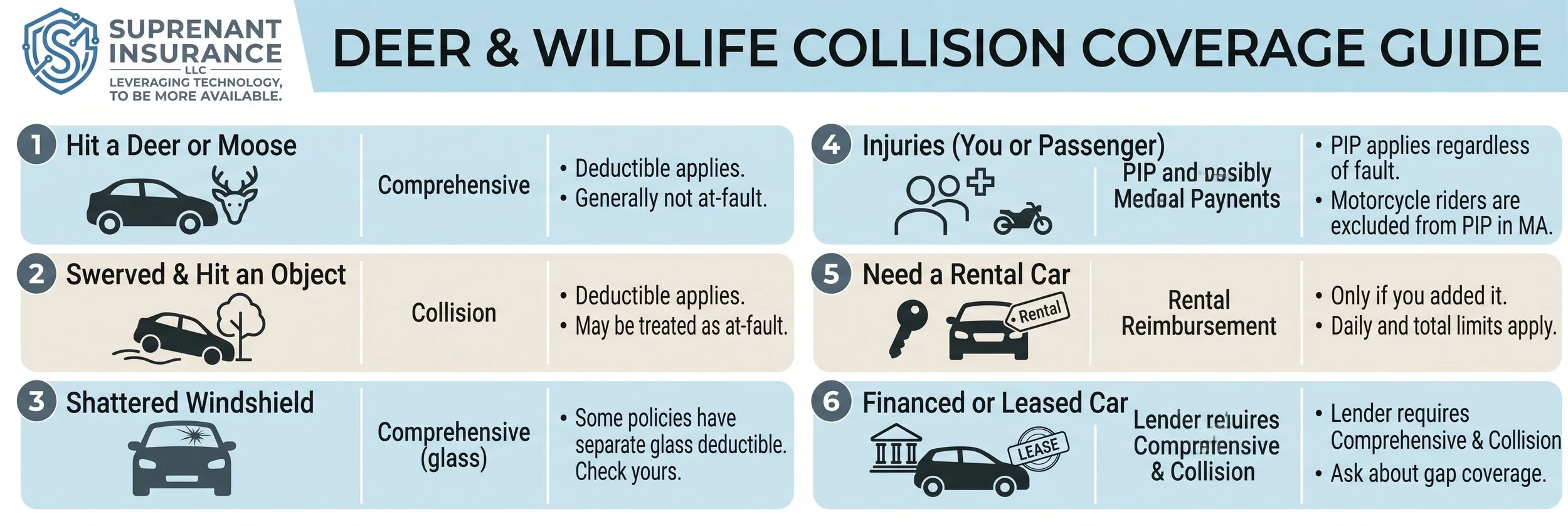
A quick reference of various situations that arise from wildlife collisions, and how auto insurance coverages respond.
The "swerve trap"
Most drivers' instinct is to jerk the wheel. MassWildlife's advice is the opposite: brake, and don't swerve, because swerving can lead to more danger and more damage than the deer itself. From an insurance standpoint, swerving can also turn what would have been a Comprehensive claim into a Collision claim, and a single-car crash can be treated as at-fault.
That's not a reason to freeze or ignore your own safety. It's a reason to know, before it happens, that the "safest for the car" and "cheapest for the claim" answers often line up: brake hard, stay in your lane, and keep control.
What to do in the first 30 minutes
Get safe. Hazard lights on, move the car off the road if it's drivable, and call 911 if anyone is hurt or the vehicle is blocking traffic.
Photograph everything. Your car from all sides, the road, the location, the time, and the animal if it's safe to do so.
Report it. MassWildlife recommends reporting deer and moose collisions to the Environmental Police at 1-800-632-8075. Also call local or State Police for a report, since it documents the loss for your claim. By Massachusetts law, you also have 5 days to file a Motor Vehicle Crash Operator Report with the RMV if there is an injury or if damage to the vehicle exceeds $1,000—which a deer strike almost always does.
Don't drive a damaged car. Leaking fluids, a hood that won't latch, or a bent wheel mean it's time for a tow.
Don't approach an injured animal. They're unpredictable and can be dangerous.
Call your agent. Reach out to us as soon as you are safe to start the claims process. Have your policy number, photos, and the police report number ready.
Ask about the deer. Massachusetts residents involved in a deer-vehicle collision may be able to salvage the roadkill deer by taking it to a MassWildlife office or Environmental Police station to be officially tagged. It's an odd little rule, but it's real (though state law explicitly forbids selling the meat).
Five things to check on your policy this week
Do all your vehicles have Comprehensive? Older cars are where people most often drop it to save money, and they're often driven the most.
What's your Comprehensive deductible? A $1,000 deductible on a $4,000 repair is a very different experience from a $250 one.
Do you have rental reimbursement? It usually costs very little compared to a few weeks of paying for a rental.
Is your glass coverage what you think it is? Deductibles vary by carrier.
Does anyone in the house drive at dusk? New and teen drivers are the ones most likely to be caught off guard. See our teen driver guide.
How to lower your odds
AAA Northeast's advice is straightforward: if you see one deer, look for more because they rarely travel alone; scan the shoulders, not just the road; slow down at dawn and dusk; and use high beams when it's safe. One more reminder: drowsy driving after the clock change increases crash risk, so give yourself a few days to adjust.
Frequently asked questions
Will a deer claim raise my rates in Massachusetts?
It depends on your carrier and claim history. Under the Massachusetts Safe Driver Insurance Plan (SDIP), a comprehensive claim from hitting an animal does not generate surcharge points. However, because carriers use their own rating plans, frequent comprehensive claims can sometimes impact loss-free discounts or tiering at renewal. We're glad to walk through how your specific policy is likely to respond.
What if I hit a moose?
The coverage logic is the same, but moose are far more dangerous to hit. Because moose are so tall, their center of gravity is above your bumper, meaning their full weight often comes directly through the windshield. MassWildlife notes moose are found in central and western Massachusetts and breed in September and October, making them a serious early-fall concern.
Does my liability coverage pay for my own car?
No. Liability pays for damage you cause to others. Damage to your own car from a deer requires Comprehensive (or Collision, if you swerve and hit something else).
What if my car is totaled?
Comprehensive typically pays the vehicle's actual cash value minus your deductible. If you're financed or leased, ask about gap coverage.
Do I have to report a deer collision?
Yes. By law, you must file a Motor Vehicle Crash Operator Report with the RMV within 5 days if there is an injury or if property damage exceeds $1,000. MassWildlife also recommends reporting to the Environmental Police, and a local police report will significantly help your insurance claim.
-John Suprenant Owner/Principle